
You don’t get enough sleep.
How rules help guide decision-making in complex systems - by Matteo Penlington

Getting the right amount of sleep is surprisingly difficult. We constantly trade off immediate enjoyment for long-term well-being. When a series ends on a cliffhanger, the mind prioritizes a solid conclusion to the storyline, and the cost shows up the next day as fatigue, reduced focus, and irritability. What often helps are external cues. An important meeting the next day pushes us to consider the impact of our present decisions and to get enough sleep.
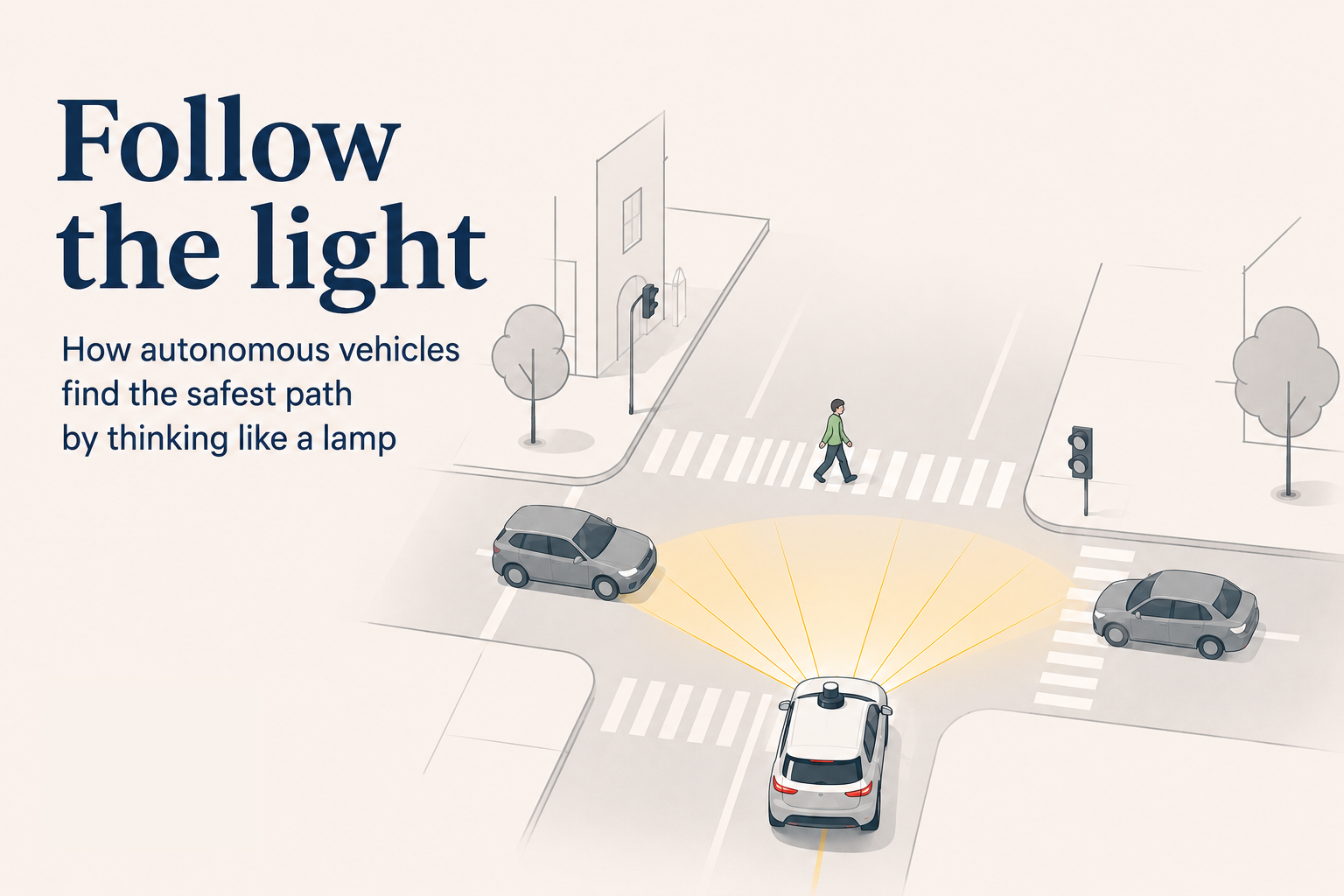
Building on this idea, my work focuses on developing a framework that identifies rules, structured guidance akin to cues, identified by design rather than by chance. These rules, unlike laws, are not designed to control or enforce behaviours, but rather to guide decision-making. The framework applies to any decision-making entity, such as a robot or self-driving car. These entities are modelled as agents, each defined by a set of core characteristics relevant to their domain. For a person, these might be affective, cognitive, and physiological systems; for a self-driving car, sensing, planning, and actuation. These characteristics influence outcomes (such as fatigue, focus, joy) and determine which rules may be useful or not. Importantly, the outcomes of these characteristics may not be directly comparable: being better rested does not necessarily compensate for a less enjoyable evening.
Because of this, there is often no single “best” rule that optimizes everything at once. Instead, different rules produce distinct trade-offs across outcomes. The framework systematically explores possible rules and evaluates the outcomes each produces. Rules where improving one characteristic would worsen another are retained as solutions: they represent different choices rather than strictly better or worse ones. Consider the sleep example again with the rule “in bed by X pm”. As X increases, evening enjoyment increases while next-day focus decreases. This predictable relationship means the framework does not need to evaluate every possible value of X; it can efficiently identify the points where meaningful trade-offs occur. Once identified, these trade-off points provide regulators, developers, and designers with a concrete set of options from which to configure their systems.
As systems become more complex, the agents within them increasingly struggle to make good decisions on their own. This is not so different from the sleep example: as children, we lacked the ability to weigh short-term enjoyment against long-term wellbeing, and our parents’ bedtime rules filled that gap. I believe well-defined rules can play a similar role in complex systems, such as helping self-driving cars navigate safely and enabling robots to coordinate in shared environments. The goal is not to dictate behaviour, but to provide guidance that allows agents to perform better than they would on their own.
Text by Matteo Penlington; illustration generated with gemini













Reliable, energy-efficient trains through smart control - by Tom Janssen