
One controller to rule them all!
How to mass-produce reliable, high-performance systems - by Vaibhav Gupta
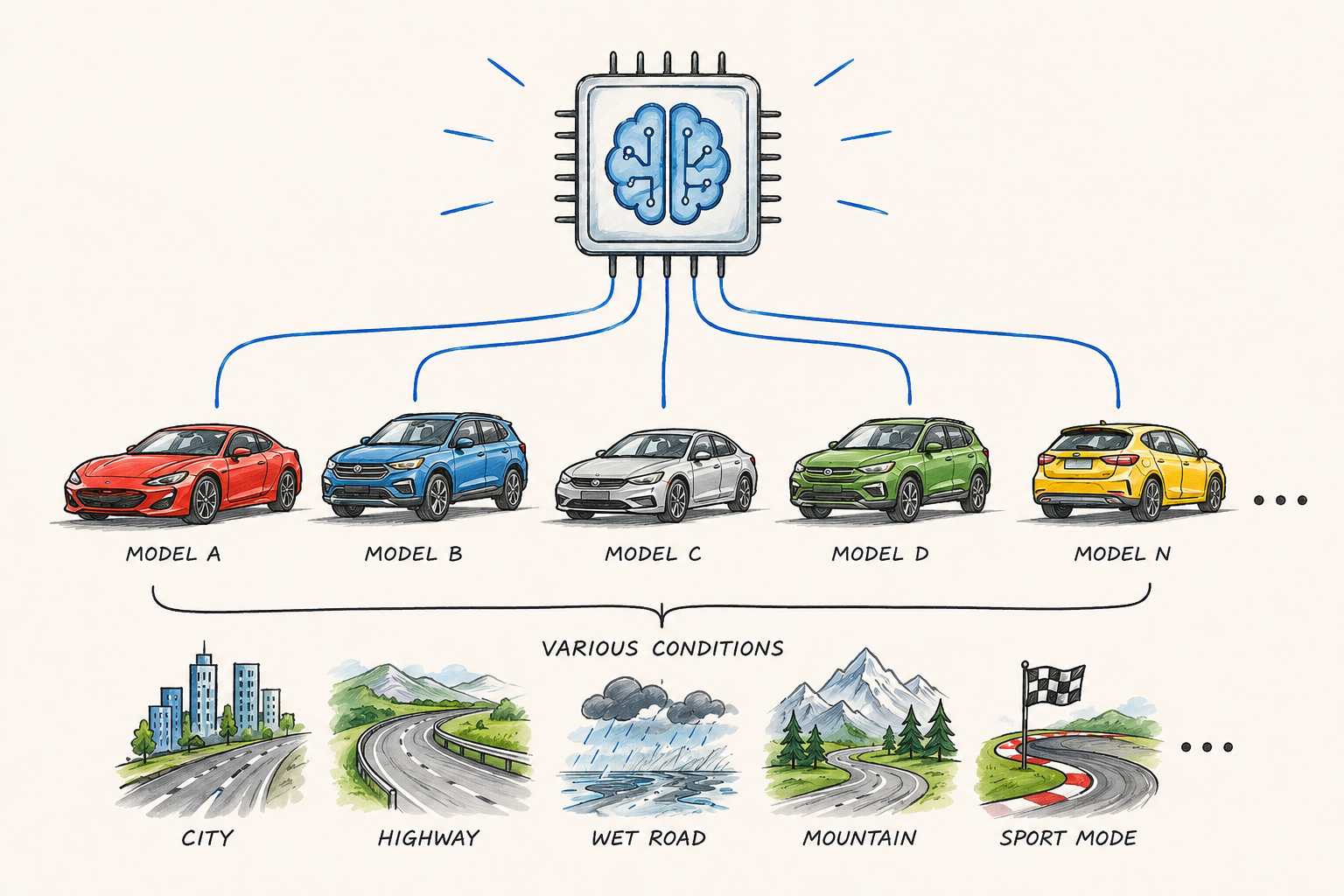
Have you ever wondered what happens when you switch your car from sports mode to city mode? One of the biggest difference lies in how the car behaves, especially while cornering. Car enthusiasts often describe this as changing the suspension setup: a softer suspension improves comfort, while a stiffer one improves performance. In many modern vehicles, these adjustments happen automatically and almost instantly thanks to a technology called active suspension.
Now imagine you are a car manufacturer producing hundreds of vehicles across multiple models. You want to equip all of them with this technology, but every model, and even how they will be driven, can be very different. As a result, the suspension system must be carefully tuned for countless combinations of vehicle types and driving conditions. Sounds complex and expensive, no? This is exactly where robust data-driven control comes in.
Data-driven control uses measurements collected from the vehicle to automatically adapt the suspension for optimal handling in different situations. However, designing and tuning a separate controller for every single car and driving condition would be impractical for mass production.
A smarter approach is to treat all variations, different car models, road conditions, and driving styles, as a part of a single family of systems. Now instead of designing many specialised controllers, one controller that performs reliably across the entire family can be designed. This ability of the controller to maintain the performance despite variations and uncertainty is what we call robustness!
My research focuses precisely on this challenge. First, I study how real-world data can be used to design flexible, high-performance control systems. Second, I investigate how to efficiently represent uncertainties (such as variations between car models) and use this information to make control systems both robust and reliable.
Text by Vaibhav Gupta; illustration generated with ChatGPT 




Learning to adjust a control algorithm without giving up what we already know - by Jonas Ohnemus