
Hedging Against Bad Luck
How control theory plans for Murphy’s Law - by Jakob Nylöf
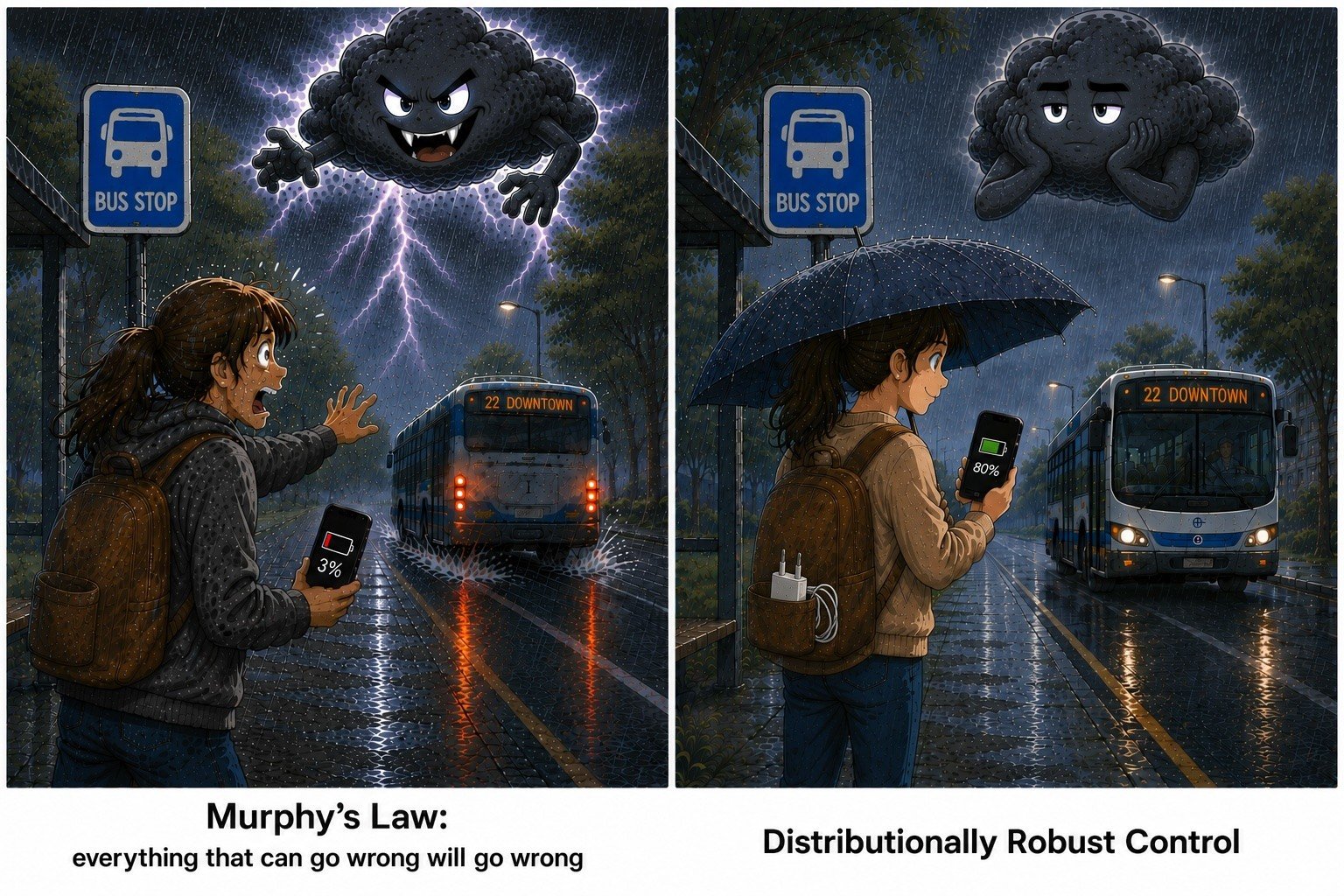
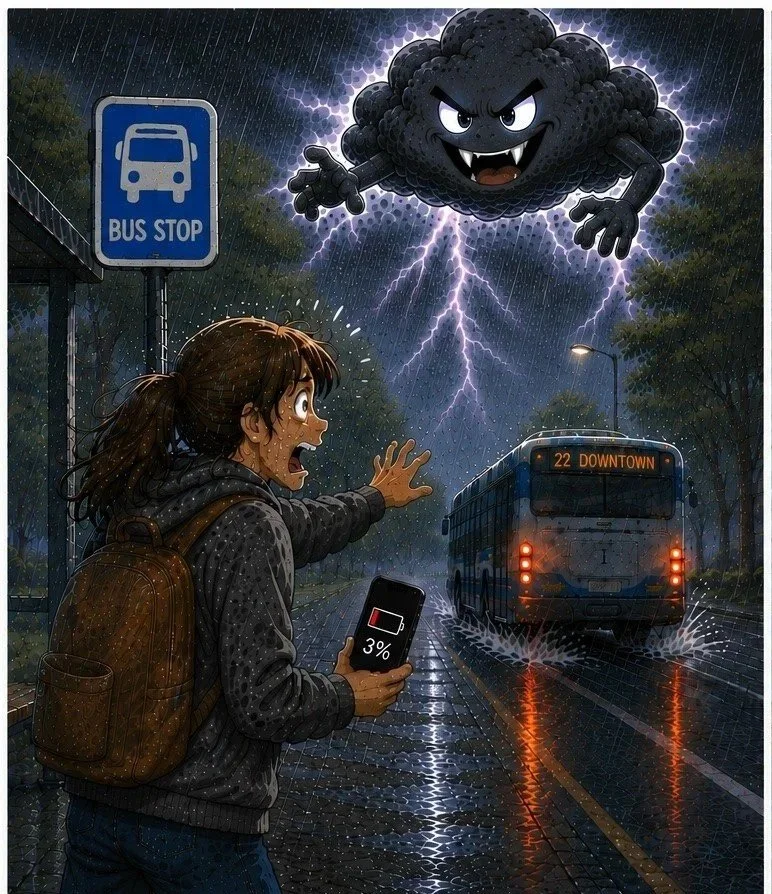
Most days, things are average. Every day is a little different, but based on what’s worked for you before, sticking to your routine usually goes fine and keeps stress manageable. But on the one day you really need everything to go smoothly, then you’re late, it’s raining, your phone is at 3%. That’s the day the bus is delayed, the zipper breaks, and the card reader is down. This is Murphy’s law. Everything that can go wrong will go wrong, that is, you are faced with the worst plausible chain of events given what you decided to do. An alternative viewpoint of Murphy’s law is that you and an evil adversary, which we will see as Nature, are playing a game. You play first and pick a routine, such as the time you head to the bus, leaving the umbrella at home or to what percentage you charge your phone. Nature plays second, can see your selected routine and aims to ruin your day by providing you with the most inconvenient version of randomness possible, such as an unusually early bus, a heavy rainstorm or your phone dying right before the train ticket inspector arrives.
In some situations, it may be preferable not to adopt such an adversarial viewpoint. Instead, imagine going about your everyday routine without knowing exactly what will happen on a given day, but also without assuming that Nature is actively working against you. In control theory, this perspective is often associated with stochastic control, which focuses on designing controllers for autonomous systems, such as robots, autonomous vehicles or economic systems, that are affected by random disturbances. The key point is that the randomness is not entirely unknown. We may have a rough understanding of which outcomes are likely and which are unlikely. In our everyday routines, no two days are exactly the same. Still, if we have a good sense of what usually happens, we can choose routines that work well most of the time. In control terminology, the routine is the control policy of the autonomous system.
In contrast, distributionally robust control is built for the Murphy’s law setting, where we may not fully trust our prior knowledge of randomness. Instead, the goal is to design a control policy that performs well even against a worst-case realization of randomness. In other words, we plan for the most unfavourable scenario we can reasonably anticipate Nature to throw against us. For our everyday routine example, this means choosing a routine that still works even if the bus is delayed, the zipper breaks, or your phone battery is at 3%. Concretely, this might mean taking an earlier bus, bringing an umbrella or carrying a phone charger.
This naturally raises important questions. How conservative is such a routine in practice? How much satisfaction do we sacrifice if the true randomness is milder than the worst case randomness we planned for? For example, an overly cautious routine could make you stay inside all day, even though it is sunny outside. Distributionally robust control is largely about navigating this trade-off between robustness and satisfaction.
Text by Jakob Nylöf; illustration generated with ChatGPT







But Stay in Control - by Thierry Schwaller