
Finding the cure is (NP)-hard!
Accelerating life-saving decisions through efficient sampling - by Buse Sen
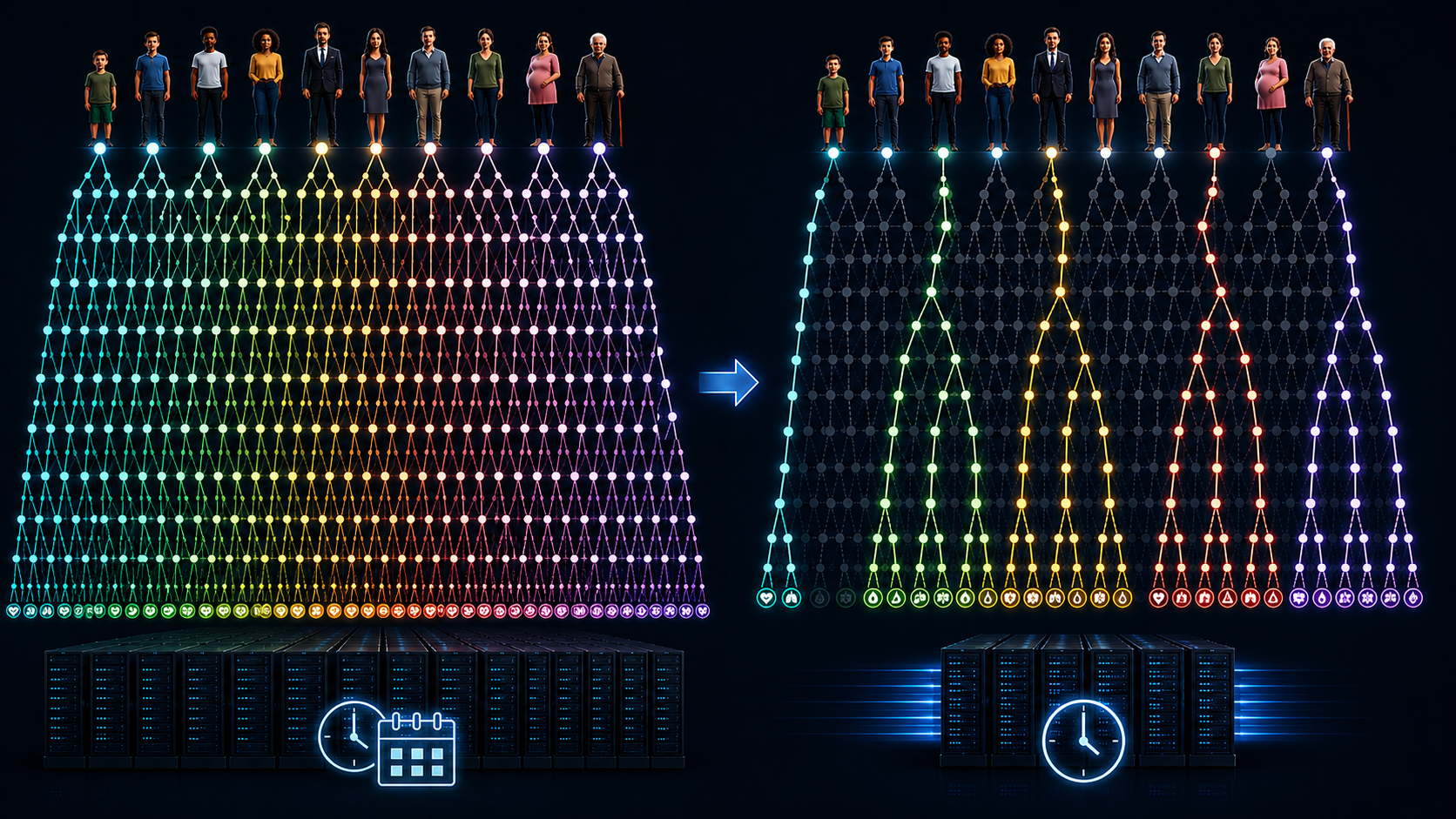
Imagine you are a doctor trying to figure out if a drug is safe or not. How do you know for sure? You need to test it on patients and collect data.
You cannot just test it on one person. You have to look at different patient profiles, say ten different types of people based on their age, genetics, and health history. But the complexity does not stop there. For each of those ten people, their bodies might react to the drug in ten different ways: maybe it cures them perfectly, maybe it causes a mild nosebleed, or maybe it spikes their blood pressure.
To truly understand if the drug is safe, a computer model has to calculate every single possibility. That is ten patients times ten reactions, which equals a hundred unique scenarios.
That may sound manageable. If a standard computer takes just one minute to simulate those hundred scenarios, you have your answer almost instantly. But in the real world, hospitals are not dealing with tens of possibilities. They are looking at thousands of unique patient profiles and hundreds of potential reactions.
If we scale up to just 10,000 patients and 100 reactions, we suddenly have one million unique scenarios. That quick one-minute calculation just turned into nearly seven days of computing. Scale that up to a regional healthcare system, and tens of millions of combinations create a massive bottleneck, locking up computers for months just to evaluate a single drug.
This exact problem is what my research solves.
I developed a tool that stops the computer from having to calculate every single one of those millions of scenarios. Instead of forcing the system to look at every possibility, my method acts as a strategic shortcut. It figures out how to pick a very small, incredibly specific handful of scenarios to check, sometimes just looking at one outcome instead of ten.
We can guarantee the exact same level of accuracy but process far fewer scenarios. If a hospital needs to be 99% sure a drug is safe, instead of calculating 1,000,000 scenarios, my method only needs to check 10,000. Eliminating 99% of the workload turns months of computing into mere hours, making data-driven, life-saving decisions dramatically faster and more reliable.
Text by Buse Sen; illustration generated with ChatGPT









How local reactions can help future grids stay in balance - by Marius Baumann