
From rapid prototyping to intelligent manufacturing
When a 3D printer starts paying attention - by Ilyas Seckin
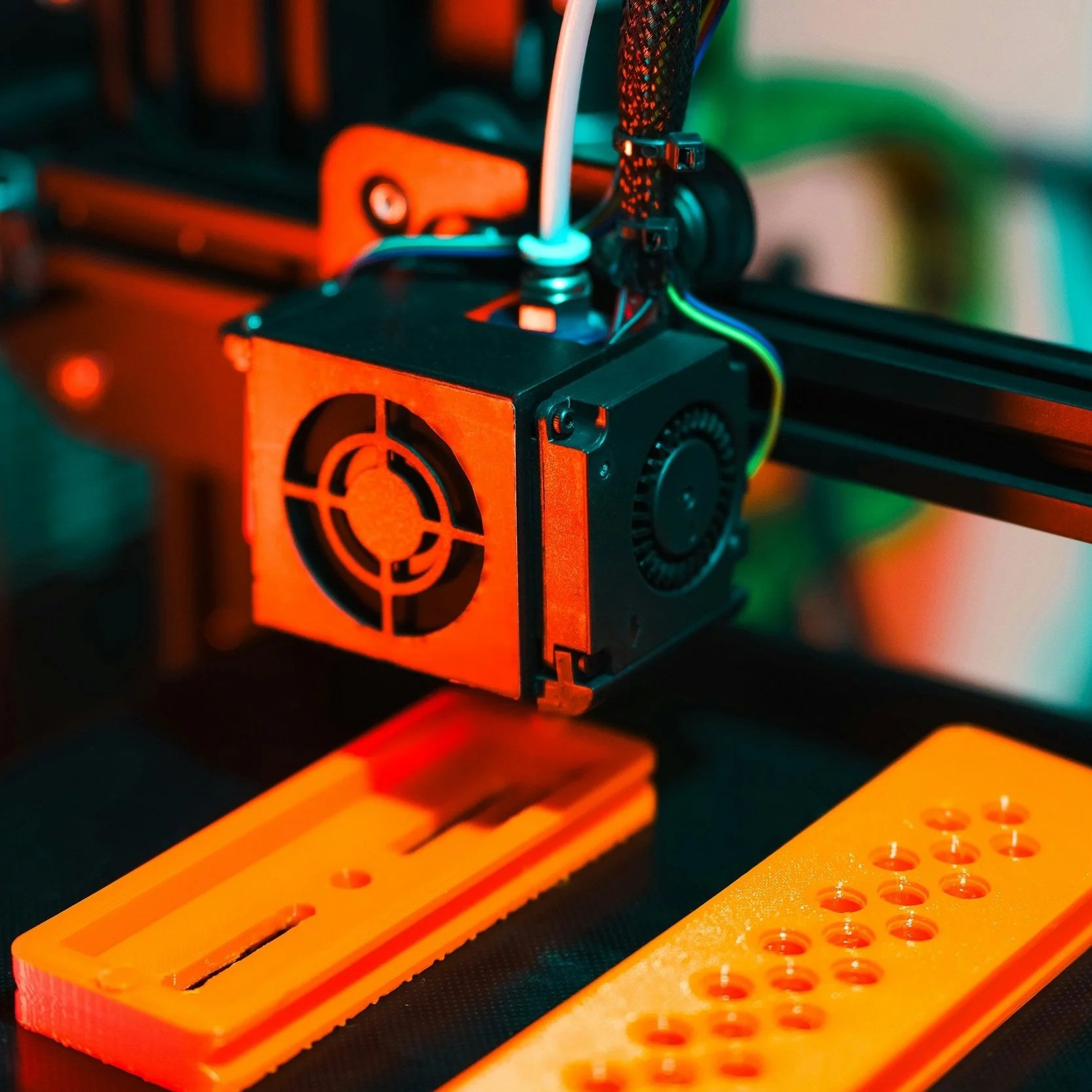
3D printing has made it possible to manufacture complex parts directly from digital designs. Most printers do this by depositing material one flat layer at a time, a process known as planar printing. Even in this well-established setting, however, the printing process is difficult to predict perfectly. Small changes in temperature, material properties, or the printing surface can affect how the material flows and, ultimately, the quality of the finished part.
More advanced systems can also deposit material along curved paths instead of flat layers. This is known as non-planar printing. It can improve mechanical performance, surface quality, and design freedom by allowing the deposited material to better follow the geometry and loading of a part. At the same time, these more complex motions make the printing process even harder to understand and control.
Our research therefore starts with a basic question: what is actually happening while a part is being printed? We study the dynamics of material extrusion in both planar and non-planar printing and investigate how printing conditions influence material flow and the resulting part.
To observe the process, we integrate sensors into the printer and collect measurements in real time. For example, measuring the force required to push material through the nozzle gives us information about the extrusion process as it happens. These measurements can help us understand the causes of defects, detect abnormal behaviour, and monitor print quality.
Once the process can be observed and understood, it can also be improved. We develop feedback-control methods that allow the printer to adapt its material flow during printing instead of simply following fixed instructions. We also explore data-driven methods that learn suitable settings from experiments and reduce the need for manual tuning.
Our long-term goal is to develop 3D printing systems that can observe, understand, and adapt to the process they are performing, enabling more reliable manufacturing and greater control over the quality and properties of printed parts.
Text by Ilyas Seckin; illustration by Jakub Żerdzicki (Unsplash)












How curiosity, rather than imitation, can help robots make sense of the physical world - by Tim Lücking