
trAIn Control
Reliable, energy-efficient trains through smart control - by Tom Janssen
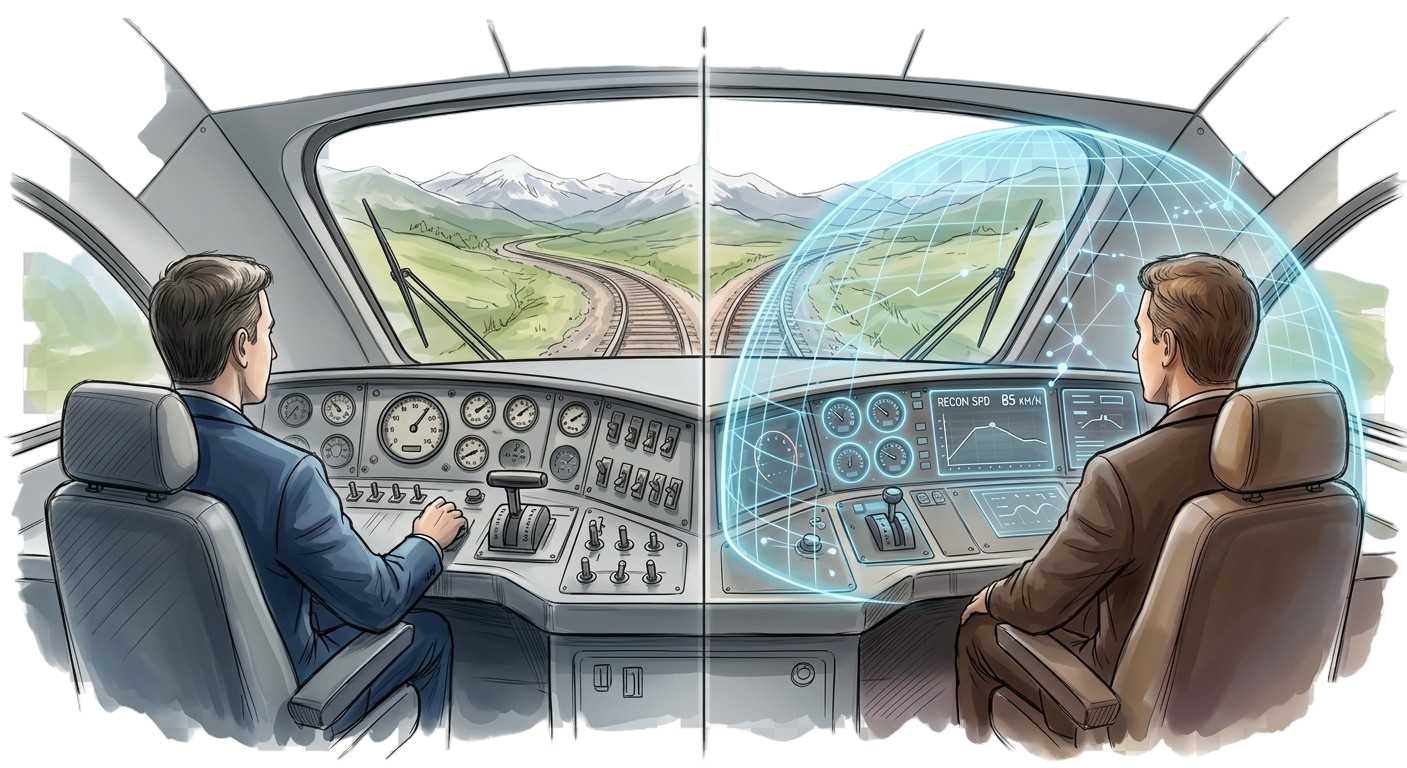
Trains in Switzerland are good. They run frequently and can take you almost anywhere. Still, there is room to improve: making trains more energy-efficient and more punctual would benefit passengers and the network alike. When a train is late, passengers may miss connections, arrive late to meetings, or need to add buffer time. We aim to improve both the reliability and energy efficiency of train operations.
To address this, we use computer models to compute a speed plan for the train: a detailed recommendation containing exactly how fast the train should travel between departure and arrival. This plan allows the train to accelerate and brake efficiently, make good use of uphill and downhill sections, and arrive on time.
Once we have this speed plan, it can be put to use in different ways. In one setup, a human driver stays in control, receiving the computer's recommendations continuously updated as conditions change, such as a delay, a stronger headwind, or a shift in the timetable. In another, the computer executes the plan directly, while a human oversees and manages the process. In both cases, closer alignment with the computed plan reduces the small deviations that can otherwise ripple into delays across the network.
Making this work reliably is not easy. First, we need to understand the train we are dealing with, since freight and passenger trains behave differently. Next, we need methods to compute the best possible speed plan. Finally, we need controllers that can reliably execute these plans in real-world conditions, such as when it is windy, when the train is full, or when initial delays occur.
Modeling the train system, computing an optimal speed plan, and designing controllers are usually studied separately, but in practice they're tightly connected, and understanding how improvements in one step affect the others is crucial. This is where our research comes in: we study how choices in one step propagate to the others, rather than optimizing each component in isolation, and design the overall system to stay robust even when individual stages fall short. Ultimately, the goal isn't a perfect model or a perfect plan, it's less energy use and trains that run on time.
Text by Tom Janssen; illustration generated with Gemini 





Reliable, energy-efficient trains through smart control - by Tom Janssen