
You cannot always be safe
Risk management in automation - by Jonathan Hilberg
There are two options in life: either you always try to stay in your comfort zone or you take a risk that can be rewarded or punished. Imagine running late by bicycle on your way to an important class. The street is filled with potholes. Are you trying to keep as much distance from the potholes as possible, or do you minimize your travel time by passing closely?
Every human has a certain risk management, and – as engineers – we have to teach robots that interact with the environment this sense of risk, too.

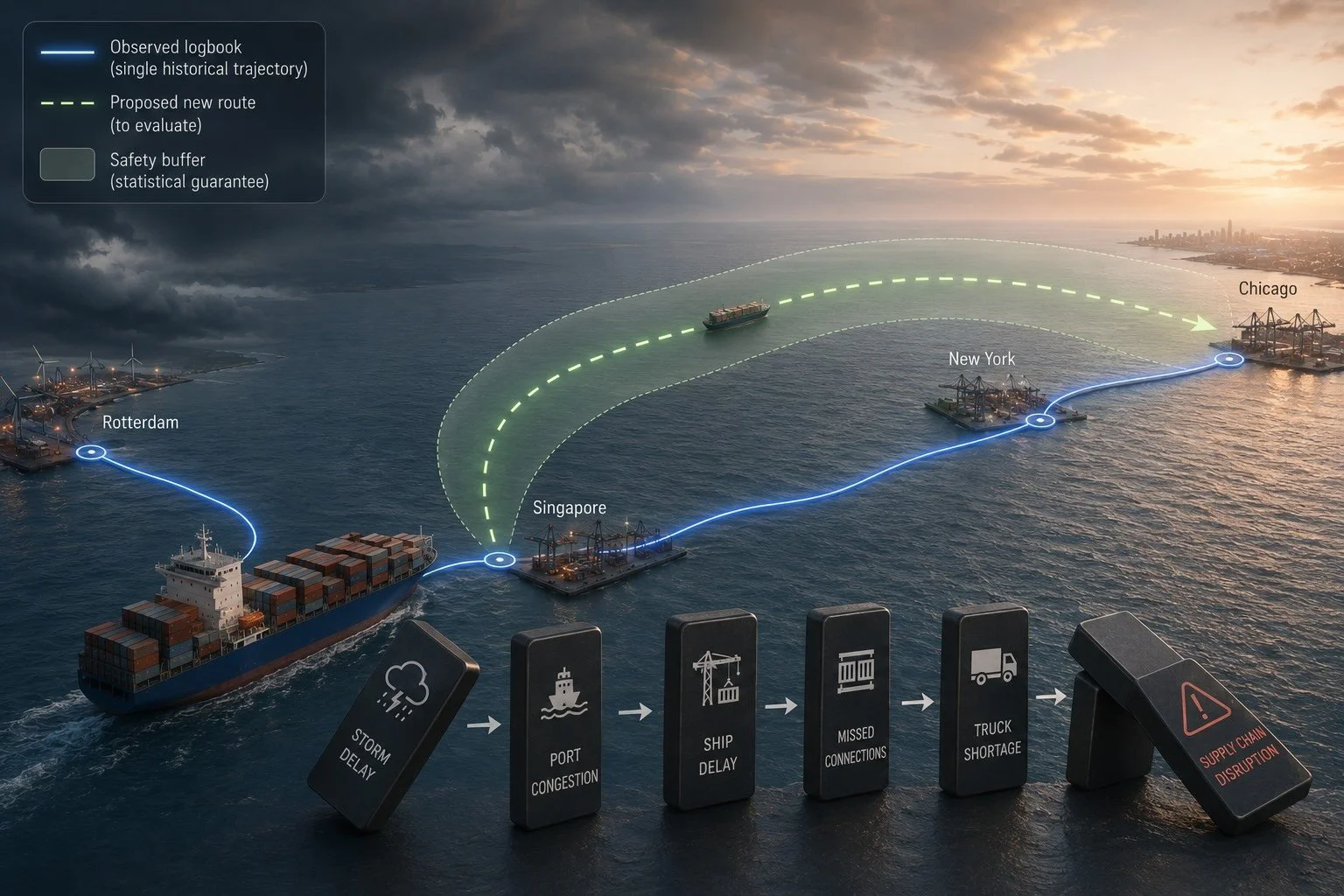
The biking scenario above can be generalized as reaching a destination while avoiding obstacles: The chosen path should be as short as possible to reduce travel time while avoiding obstacles and thus staying safe with a specific probability.
With our research, we aim to give explicit guarantees of said safety. When working with physical systems, e.g., a drone delivering a package, uncertainties about the system (e.g. wind gusts, differences between the drone model and the actual drone), make this task difficult. We address this problem by assuming boundaries around these uncertainties and developing control methods that account for them and ensure the system operates safely.
To see if our methods work in practice, as a first step from theory to application in real life, we validate and visualize them on a ball-on-a-plate-system, a mechanically actuated plate that balances a ball.
Text by Jonathan Hilberg; picture created with DALL-E






Related articles
Guaranteed safety even in uncertain environments - by Jair Reyes Gutierrez